
Marketing for paving contractors has changed.
Relying on referrals alone no longer creates predictable commercial paving jobs.
Property managers change, budgets shift, and when referrals slow down, growth becomes accidental instead of intentional.
Contractors who want consistent commercial work need a marketing system built for planning, not urgency.
This article explains how paving contractors can consistently generate commercial jobs without relying on word-of-mouth — and why most “lead generation” efforts fail to do this.
👉 Looking for a complete paving contractor marketing system that generates commercial paving leads?
Start here → [paving contractor marketing]
Why Referral-Based Marketing Fails for Paving Contractors
Referrals are reactive by nature.
They depend on:
-
Someone else noticing a problem
-
Someone else remembering your name
-
Someone else deciding to reach out
That means you’re never in control of timing or volume.
Most contractors don’t notice the problem until:
-
Crews are idle
-
Revenue becomes uneven
-
Growth stalls despite good work
Referrals don’t disappear because you did something wrong.
They disappear because they were never a system to begin with.
The Real Difference Between Residential and Commercial Paving Marketing
Residential paving responds to urgency.
Commercial paving responds to planning.
Property managers, HOAs, and asset managers don’t wake up needing asphalt work today.
They plan maintenance cycles, budgets, inspections, and site walks.
That changes everything about marketing.
Commercial marketing must:
-
Appear before the decision is made
-
Build confidence before a bid is requested
-
Position you as a long-term solution, not a quick fix
This is why most paving ads fail.
They are built for homeowners, not decision-makers.
Why “More Leads” Is the Wrong Goal
Most marketing agencies sell volume.
More forms.
More calls.
More emails.
But commercial paving does not suffer from a lack of leads.
It suffers from a lack of qualified site-level conversations.
A property manager doesn’t want to “talk.”
They want to assess risk, cost, and disruption.
If your marketing doesn’t move the conversation toward a site visit, it creates noise, not growth.
The Shift: From Lead Generation to Site Visit Generation
Commercial paving decisions are made on-site.
Drainage.
Base conditions.
Traffic flow.
ADA risk.
Future maintenance planning.
Marketing that works for commercial paving does one thing well:
It gets the right people to invite you to walk the property.
That is the core shift.
Not:
-
“Get more leads”
But:
-
“Get more site visits from qualified commercial properties”
Everything else supports that goal.
What Paving Contractors Can Do Right Now to Generate Commercial Jobs
This isn’t theory.
These are practical actions commercial paving contractors can implement without rebuilding their entire business.
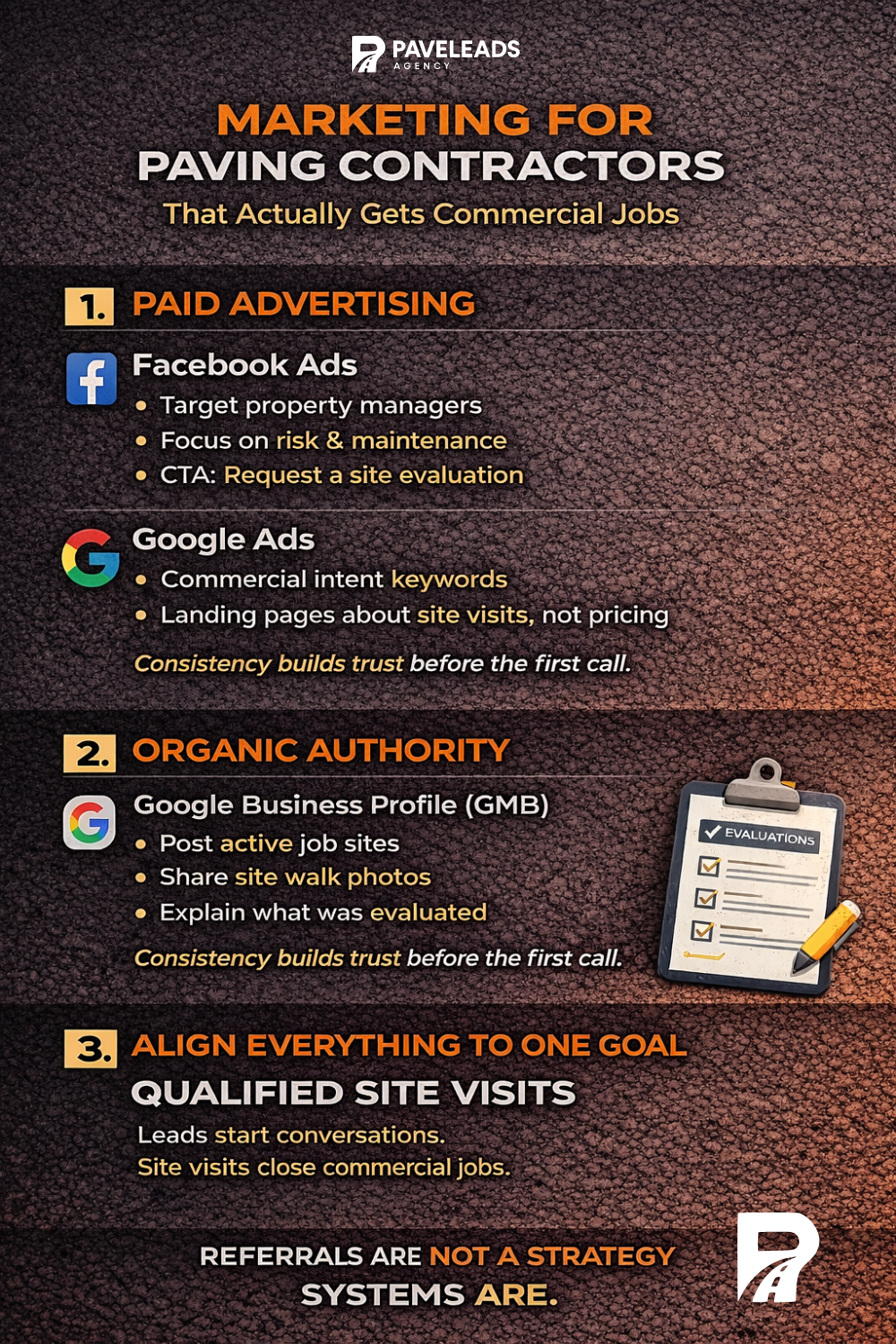
1. Paid Advertising: Use Ads to Create Site Visits, Not “Leads”
Paid advertising works for paving contractors only when the goal is right.
Facebook Ads
Facebook is effective for commercial paving when it’s used to interrupt, not to close.
What works:
-
Target property managers, facility managers, and business owners
-
Ads focused on risk, maintenance, and future failure
-
Calls to action like:
-
“Request a Site Evaluation”
-
“Schedule a Property Walk”
-
What doesn’t:
-
“Get a free quote”
-
Discount-driven messaging
-
Residential-style visuals
Facebook ads are about starting the conversation, not finishing it.
Some Example ADS For Facebook With This Estructure:
Google Ads
Google captures existing intent.
It works best when:
-
Keywords are commercial-specific
-
Landing pages talk about site evaluations, not pricing
-
Ads position you as a specialist, not a general contractor
Think:
-
“Commercial paving contractor”
-
“Parking lot maintenance planning”
-
“Asphalt site evaluation”
Google is where decision-makers go once they’re already thinking about a problem.
2. Organic Growth: Google Business Profile (GMB) Is Non-Negotiable
Most paving contractors underuse their Google Business Profile.
For commercial work, GMB should communicate:
-
Commercial experience
-
Site-level expertise
-
Ongoing projects, not just finished ones
What to post:
-
Active job photos
-
Site walk documentation
-
Before conditions, not just after results
-
Short explanations of what was evaluated on-site
This builds trust before the first call.
Consistency matters more than perfection.
3. Position Everything Around the Site Visit
Every channel should point to the same outcome.
Ads.
Organic posts.
Website copy.
All roads lead to:
“Let’s walk the property.”
When marketing is aligned around this step:
-
Conversations improve
-
Pricing pressure drops
-
Commercial jobs become easier to win
The Takeaway
You don’t need more tools.
You need alignment.
Paid ads create awareness.
GMB builds credibility.
The site visit closes the gap.
That’s how commercial paving marketing actually works.
Final Thought
Commercial paving businesses don’t need more exposure.
They need better positioning.
Marketing for paving contractors works when it respects how commercial decisions are made — and when it guides prospects toward the only step that truly matters: the site visit.
Referrals can still exist.
They just stop being the foundation.
Ready to Build a Predictable Commercial Pipeline?
If you want a marketing system designed specifically to generate qualified commercial site visits, not just leads, we help paving contractors build that structure.
Our approach focuses on:
-
Commercial-first messaging
-
Lead qualification by intent
-
Site visit–driven conversion paths
You don’t need more calls.
You need better ones.
Start here → [paving contractor marketing]