
For most paving contractors, the problem isn’t winter.
The problem is waiting until spring to market.
Commercial paving decisions don’t start when the weather improves.
They start months earlier — during budgeting, inspections, and planning cycles.
Contractors who stay busy year-round aren’t chasing emergency work.
They’re positioning themselves before projects are released.
This article breaks down how to keep a commercial pipeline active all year, even during off-season months.
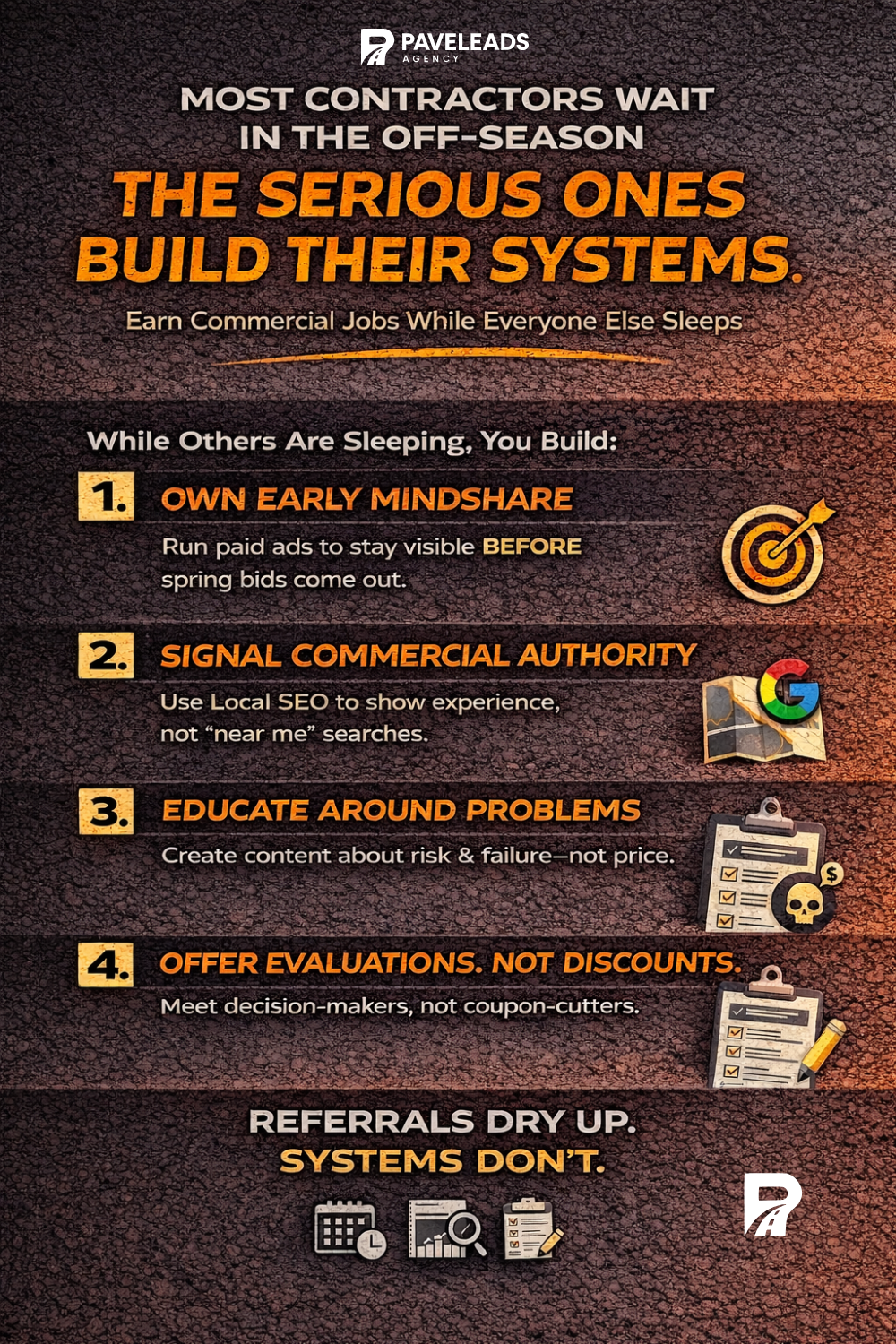
While most paving contractors slow down in the off-season, the smartest ones go quiet for a different reason.
They’re not chasing work.
They’re building systems.
When crews are parked and phones ring less, most contractors mentally check out. Marketing stops. Content stops. Ads stop.
Spring becomes a restart.
That’s a mistake.
Because commercial paving isn’t won in spring.
It’s won months earlier, while everyone else is asleep.
If you want spring to feel busy instead of desperate, the off-season is where the work actually happens.
While Others Are Sleeping, Serious Contractors Are Building Their Pipeline
Off-season isn’t downtime.
It’s leverage time.
This is when:
-
Property managers plan budgets
-
Assets are inspected
-
Maintenance priorities are decided
-
Vendor shortlists are created
By the time asphalt season starts, decisions are already in motion.
Contractors who show up late don’t compete on strategy.
They compete on price.
This article breaks down how to use the off-season to build a commercial marketing system so spring doesn’t rely on luck, referrals, or panic ads.
1. Use Paid Advertising to Stay Present While Everyone Else Disappears
Paid ads during off-season are misunderstood.
They’re not about “getting more leads right now.”
They’re about owning mental real estate before demand spikes.
Facebook Ads: Interrupt the Right People
Facebook works when you use it to interrupt decision-makers, not homeowners.
Target:
-
Property managers
-
Facility managers
-
Commercial asset owners
Message around:
-
Deferred maintenance risk
-
Planning ahead
-
Long-term pavement performance
CTAs that work:
-
Request a site evaluation
-
Schedule a property walk
CTAs that fail:
-
“Get a free quote”
-
“Limited-time discount”
Off-season Facebook ads are about recognition and positioning, not closing.
Google Ads: Capture Early Intent
Even in winter, commercial searches continue.
What matters is intent.
Bid on:
-
Commercial paving contractor
-
Parking lot maintenance planning
-
Asphalt site evaluation
Your landing pages should:
-
Talk about evaluations
-
Explain decision processes
-
Avoid price-first language
Google is where buyers confirm seriousness.
If your message feels residential, you lose credibility instantly.
2. Use Local SEO to Build Authority, Not Traffic
Most contractors treat SEO like a volume game.
More clicks.
More traffic.
More “near me” searches.
That’s noise.
Commercial SEO is about authority signaling.
Google Business Profile Is a Trust Asset
Your GMB profile should look like a live operation, not a portfolio.
Post:
-
Active job sites
-
Site walk photos
-
Before-condition images
-
Short explanations of what was evaluated and why
This tells Google — and buyers — one thing:
“These guys understand commercial pavement systems.”
While others go dark, your profile keeps working.
3. Educate Around Risk While Others Sell Price
Off-season content should not be promotional.
It should be educational and uncomfortable.
Commercial buyers don’t respond to:
-
Discounts
-
Before/after fluff
-
Generic service lists
They respond to:
-
Risk
-
Failure
-
Long-term cost exposure
Topics that position authority:
-
Why winter accelerates pavement failure
-
Why surface appearance is misleading
-
Why deferred maintenance costs more in spring
This reframes you from “contractor” to advisor.
4. Offer Evaluations Instead of Discounts
Discounts are lazy marketing.
They attract buyers who disappear the moment someone is cheaper.
Commercial clients don’t want coupons.
They want clarity.
Off-season is perfect for:
-
Site evaluations
-
Condition reports
-
Maintenance planning sessions
An evaluation:
-
Lowers resistance
-
Builds trust
-
Creates a roadmap for spring work
You’re not selling asphalt.
You’re selling foresight.
5. Build a Site-Visit-First Conversion System
Here’s where most contractors lose control.
Their entire funnel points to:
-
“Contact us”
-
“Get a quote”
-
“Call now”
Commercial paving doesn’t work that way.
Everything should point to one outcome:
Walk the property.
Ads → site evaluations
SEO → site evaluations
Content → site evaluations
Leads start conversations.
Site visits create commercial jobs.
This is the difference between noise and pipeline.
6. Use the Off-Season to Fix the System, Not Chase Work
Spring exposes weak systems.
If your marketing depends on:
-
Referrals
-
Last-minute ads
-
Price pressure
Spring will feel chaotic.
The off-season is when you:
-
Clean up messaging
-
Align channels
-
Build consistent inbound demand
While others wait for calls, you build predictability.
7. Replace Referral Dependence With Systems
Referrals feel good.
They also make your business fragile.
They depend on:
-
Memory
-
Timing
-
Someone else’s urgency
Systems don’t.
A real marketing system:
-
Generates inbound demand
-
Filters unqualified work
-
Smooths cash flow
-
Supports planning and scale
Referrals can stay.
They just stop running the business.
Final Thought
Off-season is when the gap is created.
While others are sleeping, serious paving contractors are:
-
Improving positioning
-
Building authority
-
Creating systems for spring
When the season starts, they don’t scramble.
They execute.
Referrals dry up.
Systems don’t.
Want Spring to Feel Predictable This Year?
If you want a marketing system built to generate qualified commercial site visits, not random leads, that’s exactly what we help paving contractors create.
This isn’t about more activity.
It’s about control.