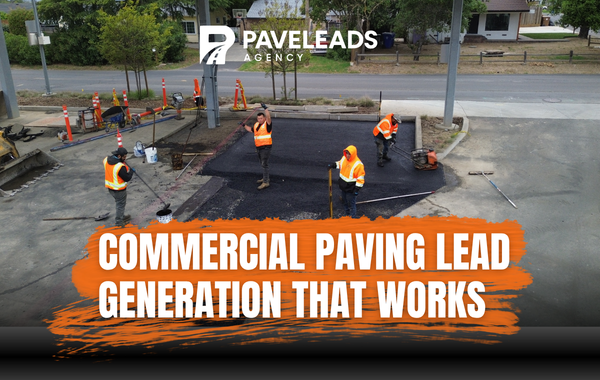
If your crews are ready, your equipment is sitting, and your phone is still depending on referrals, you do not have a marketing problem. You have a pipeline problem. Commercial paving lead generation is what fixes it - not more random ads, not another generic agency, and definitely not waiting for property managers to remember your name when budgets open up.
Commercial work is not won the same way residential jobs are won. The buyer is different. The sales cycle is longer. The deal value is higher, but so is the friction. You are dealing with property managers, facility directors, HOAs, retail groups, and owners who care about risk, timing, documentation, and whether your team can actually show up and execute without creating headaches. If your lead flow is built like a residential contractor's, you are already behind.
Why commercial paving lead generation breaks for most contractors
Most paving companies are trying to grow commercial revenue with a patchwork system. One person runs a few ads. Someone else answers the phone when they can. Estimates sit in a truck for two days. Follow-up depends on memory. The CRM is either a spreadsheet or nothing at all. Then owners wonder why leads "aren't good."
The truth is harsher. A lot of leads are wasted by weak handling, slow response time, and zero qualification. If a property manager fills out a form and hears nothing for six hours, that lead did not go cold on its own. It was dropped.
This is where most agencies get it wrong too. They sell clicks, impressions, and traffic, then disappear when those numbers fail to turn into booked work. That does not help a paving contractor trying to keep crews moving through the season and protect margins. You do not need more activity. You need more qualified commercial opportunities that actually turn into estimates, site visits, and jobs.
What a real commercial paving lead generation system looks like
A real system starts before the lead ever comes in. The targeting has to be built around commercial buyers, not homeowners. That means the messaging, offer, and ad strategy should speak directly to the problems those buyers care about: liability, ADA issues, poor curb appeal, tenant complaints, safety risks, deferred maintenance, and budget planning.
Then the handoff matters. Bad systems dump every lead into the same inbox and hope someone calls back. Strong systems qualify, route, and follow up automatically so the right prospect gets the right response fast. That speed alone can separate you from half your market.
After that, the sales layer takes over. Calendar booking, estimate scheduling, reminder sequences, and follow-up workflows are not extras. They are part of lead generation. If the prospect never gets to a booked appointment, the lead did not do its job.
That is why commercial paving lead generation should be treated like an operating system, not a campaign. It has to create demand, screen buyers, reduce admin drag, and help your team close. Otherwise you are paying for noise.
The leads that matter are not just leads
A form fill from a homeowner asking for a driveway quote is not the same as a property manager responsible for five retail centers. Yet too many contractors judge marketing by lead count alone.
Lead volume can make you feel busy. Qualified commercial demand makes you profitable.
That distinction matters because commercial jobs usually involve more touchpoints, more stakeholders, and more follow-up. A smaller number of well-matched opportunities can outperform a big pile of cheap inquiries that never move. If your close rate is weak, the answer is not always buying more leads. Sometimes the answer is tightening qualification so your estimators stop chasing dead ends.
There is always a trade-off here. If you make qualification too strict, you may miss future opportunities that are early in the buying cycle. If you make it too loose, your team wastes time. The right balance depends on capacity, service mix, market density, and how aggressive you want to be about growth.
Why timing beats brand awareness
Brand awareness has its place, but most contractors use it as a polite excuse for not building a sales system. Commercial buyers do not hand out work because they vaguely recognize your logo. They move when there is a property issue, a budget window, a compliance concern, or a resurfacing need that can no longer wait.
That means your marketing has to show up at the right time with the right message and a clear next step. If your ad, landing page, and follow-up sequence are not built for action, you are just paying to be seen.
This is especially true in paving, where urgency is often tied to seasonality. You might have a short runway to fill a month, recover from weather delays, or lock in work before winter. A system that captures demand and gets prospects booked fast is worth more than a broad branding campaign that might pay off someday.
The biggest bottleneck is usually follow-up
Contractors love to blame lead quality because it feels external. Follow-up is internal, and that makes it harder to admit. But if your response process is slow, inconsistent, or manual, it will crush performance.
Commercial buyers are busy. They are fielding tenant issues, juggling vendor calls, and managing deadlines across multiple properties. If your process makes them chase you, you lose. Fast confirmations, automated reminders, and persistent but professional follow-up give you an edge because they reduce friction.
This is not about spamming people. It is about building a buying path that makes it easy for serious prospects to take the next step. Done right, automation does not feel robotic. It feels organized.
For many paving companies, this is the point where growth either accelerates or stalls. If the owner is still acting as estimator, sales manager, and follow-up coordinator, the business will eventually hit a ceiling. Systems remove that ceiling.
What to measure in commercial paving lead generation
If you are only tracking cost per lead, you are missing the point. Cheap leads can be expensive if they waste estimator time or drag your close rate down.
The better metrics are closer to revenue. Look at how many leads match your service area and job type, how many book appointments, how many turn into bids, and how many close. Track speed to first contact and follow-up consistency too. Those numbers tell you whether the machine is actually working.
It also helps to look at sales cycle length by service. Striping, sealcoating, ADA compliance, and full paving jobs do not move at the same speed. A healthy system accounts for those differences instead of forcing every lead through the same process.
This is where specialization matters. A generalist marketer may understand advertising. That does not mean they understand how commercial paving buyers think, what objections they raise, or why certain service lines convert differently. In this industry, niche knowledge is not a bonus. It is leverage.
Why specialization wins
Commercial paving is not a side category. It is its own game with its own buyer behavior, sales friction, and operational realities. If your marketing partner does not understand seasonality, rain delays, crew loading, bid pressure, and the difference between chasing junk and booking real work, they will build the wrong system.
That is why specialized agencies outperform generic ones. They know the language, the urgency, the services, and the buying triggers. They know that a booked site visit is more valuable than a report full of clicks. They know that getting your calendar filled with the right commercial prospects changes the business faster than any vanity metric ever will.
That is also why companies like PaveLeads focus on the full chain, from targeted outreach to qualification to automation to booking. It is not just marketing. It is a growth engine built for contractors who are done guessing.
The real goal is control
The point of commercial paving lead generation is not to make your phone ring a little more. The point is to take control of revenue so referrals stop dictating your future.
When your pipeline is predictable, everything gets easier. You can plan hiring with more confidence. You can protect pricing instead of racing to the bottom. You can keep crews productive and make smarter calls about expansion, equipment, and season planning.
And yes, there is still no magic button. Market conditions matter. Offer strength matters. Sales discipline matters. But a strong lead generation system gives you leverage where most contractors have chaos.
That is the difference. Hope is not a strategy. A system is. If you want more commercial jobs, build the machine that brings them in, qualifies them fast, and puts them on your calendar before your competitor even calls back.